How to declare in 13-card rummy
Five exact example hands, the final discard, and a checklist for spotting common declaration mistakes.
Declaring is the moment you win a hand of 13-card Indian Rummy. You have arranged all your cards into valid groups, you make one final move, and you show your hand. It is also the costliest place to make a mistake: on RummyDen about one declaration in twelve is invalid, and an invalid declaration costs 80 points at the default cap.
What a valid declaration requires
To declare, all 13 of your cards must be arranged into valid sequences and sets, with no leftover ungrouped cards. One more rule accounts for about six in ten invalid declarations on RummyDen:
Your hand must contain at least two sequences, and at least one of them must be a pure sequence. A quick refresher on the building blocks:
- Pure sequence — three or more consecutive cards of the same suit, with no joker used. For example, 5-6-7 of hearts.
- Impure sequence — a run of the same suit where a joker fills a gap, such as 8-9-Joker of spades standing in for the ten.
- Set — three or four cards of the same rank in different suits, like three queens.
Without a pure sequence, your declaration is invalid even if every other group is complete. If every sequence uses a joker, none is pure — and on RummyDen a wild-rank card counts as a joker even in its natural place. This rule is about declaring only: when you lose, your valid groups are left out of your deadwood count even without a pure sequence. If the rules of grouping are still fuzzy, read the rummy rules before your first round.
The finish and discard step
You do not simply announce a win. In 13-card rummy you hold 13 cards, then on your turn you draw a 14th card from the closed or open pile. To declare on RummyDen, you drag that extra card onto the finish slot, which leaves exactly 13 cards to group, and tap Declare.
The card you put on the finish slot is your last discard. It should be the one card your arrangement does not need. A common mistake is finishing with a card that was completing a group, then finding the remaining 13 no longer form valid sequences. Once you place the finish card and confirm the show, you cannot take it back.
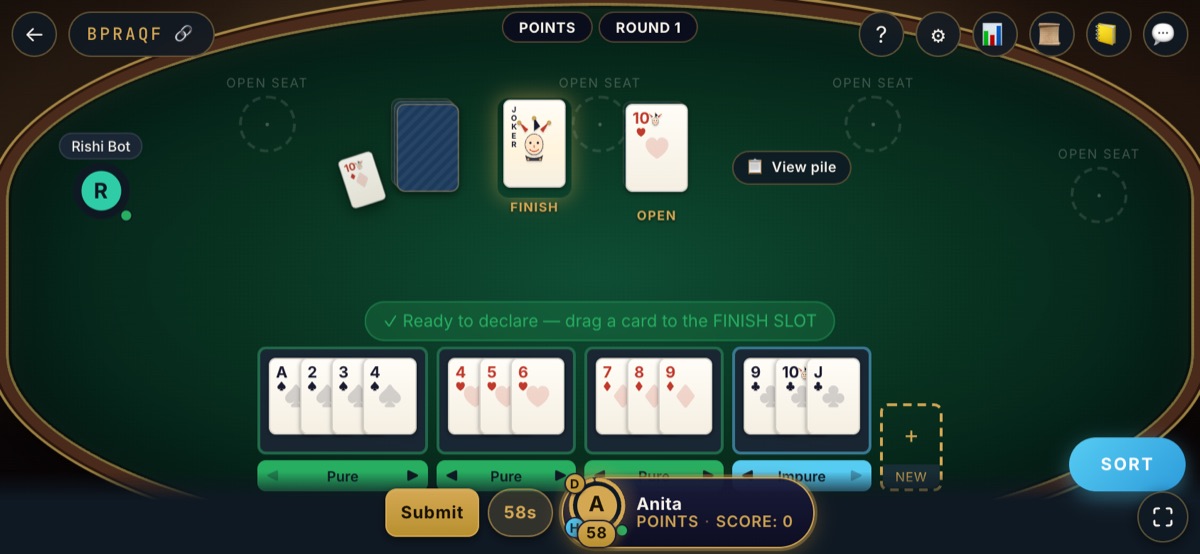
Once a valid declaration is accepted, everyone else gets the same 60-second window to arrange their own cards before scores are counted, so a losing player can still group what they hold and reduce their score.
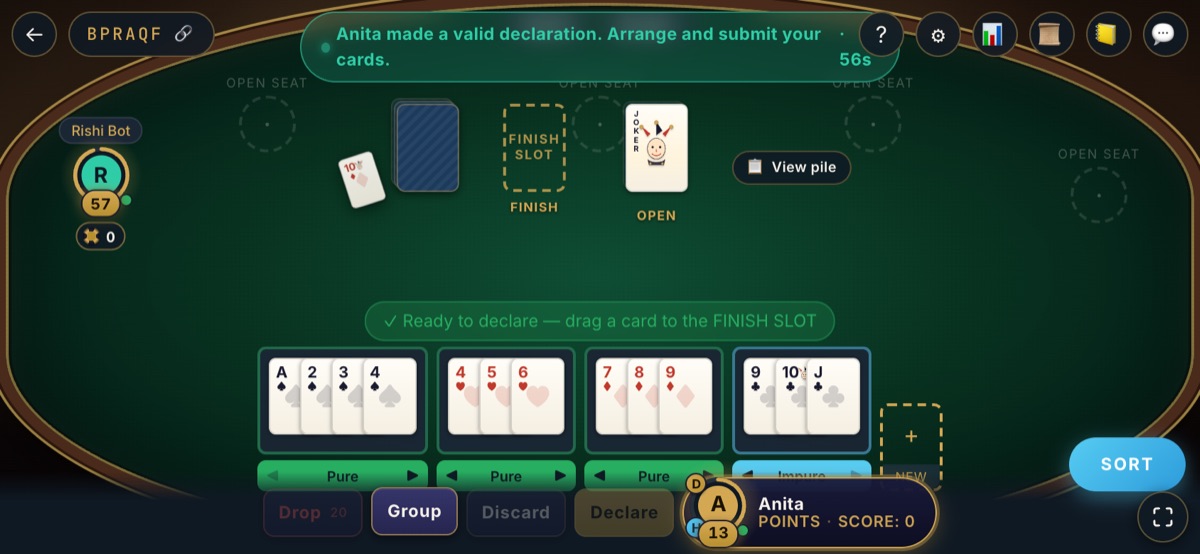
How to arrange your 13 cards into groups
Arranging your cards carefully is how you catch your own mistakes. Work in this order:
- Build your pure sequence first. Find three or more same-suit cards in a row with no joker, and lock them into a group.
- Build a second sequence. It can be pure or impure. Now you have satisfied the two-sequence rule.
- Group the remaining cards into sets or more sequences. Use jokers here, not in your pure sequence.
- Read the labels. On RummyDen, tap Sort, then drag cards between groups or select several and tap Group. The table labels each group Pure, Impure, Set or Invalid, so a missing sequence shows up before you declare.
Arranging pure-first means that if you run short on cards, the group that breaks is a set or an impure sequence, never the pure sequence that keeps your whole declaration legal. For deeper card-picking logic, our rummy strategy guide covers which cards to hold and which to let go.
Valid vs invalid declaration examples
Every example below contains exactly 13 cards, shown group by group. Wild-rank cards have a gold outline; the dark card is a printed joker. Unless a wild rank is shown, only printed jokers act as jokers.
Two pure sequences and two sets
Valid declaration · Wild rank: none
13 cards: two pure sequences and two sets. Every card belongs to a valid group.
One pure sequence plus joker groups
Valid declaration · Wild rank: 7
13 cards. With 7 wild, 5H 6H 7H is impure; the spade and club sequences remain pure. JK completes the king set.
Four sets, no sequences
Invalid declaration · Wild rank: none
All 13 cards form sets, but there is no pure sequence and no second sequence. Zero deadwood does not make a valid declaration.
Only one sequence
Invalid declaration · Wild rank: none
13 cards and one pure sequence, but the required second sequence is missing.
A set repeats a suit
Invalid declaration · Wild rank: none
13 cards and two sequences, but QH QH QC is not a set: natural cards in a set must have different suits, even in a two-deck game.
Try the first three examples directly in the hand checker, or paste any example with one group per line. Set the wild rank to match the example.
The invalid examples are not random hands: each one puts all 13 cards into groups and looks finished at a glance. That is why the pure-sequence and two-sequence checks matter.
Double-check before you declare
A hand can look done and still fail the sequence rules. Before you press Declare, check three things: a pure sequence exists, a second sequence exists, and no card sits outside a group. Then read the pure sequence card by card: same suit, consecutive, no printed joker and no wild-rank card. If any check fails, keep playing.
The penalty for a wrong show
On RummyDen, an invalid declaration receives the full-cap penalty — 80 points at the default cap — regardless of how many other groups are valid, and the round ends. It goes to the other player still in or, if several are, to whoever holds the fewest points. These are social game points, never money.
What goes wrong in real games
We looked at all 158 invalid declarations (8.4% of 1,885) in 2,259 real rounds on RummyDen. Three mistakes account for most of them:
| Mistake | Share of invalid declarations |
|---|---|
| No pure sequence at all | 33.5% |
| A pure sequence, but no second sequence | 28.5% |
| One group that is neither a sequence nor a set | 25.3% |
The first two are the same oversight: checking that every card is grouped, but not checking which kind of groups you have. Make "pure sequence? second sequence?" the last thing you confirm before the finish slot. The third is usually a set that repeats a suit — easy to do with two decks — or a run with a gap no joker fills. Full numbers in our rummy statistics.
Your pre-declare checklist
Run this list, in order, every time. If any answer is no, stop and rearrange.
- Do I have at least one pure sequence — same suit, in a row, no joker?
- Do I have a second sequence, pure or impure?
- Are my remaining cards grouped into valid sets or sequences, with nothing loose?
- Is my finish discard a card that no group needs?
- After the discard, do I have exactly 13 grouped cards?
- Have I re-read my pure sequence to make sure it holds no joker or wild-rank card?
Use this checklist to catch common errors before submitting. If you are still learning the flow of a turn — draw, meld, discard — start with our how to play walkthrough, then practise declaring at your own pace. When you are ready, create a free private room and invite a few friends.