13-card Indian Rummy rules
The complete rules of Points Rummy as RummyDen plays them — with card examples, scoring and the few places our tables differ from common house rules.
Indian Rummy is played with 13 cards. The goal is to arrange all of them into valid sequences and sets, then declare before anyone else does. This page covers every rule RummyDen's game server applies at a standard table. If you have never played, the how-to-play walkthrough is a gentler start; if you just need a quick check, use the summary below.
हिंदी में पढ़ें: रमी के नियम (हिंदी में)
The rules in 30 seconds
- Each player gets 13 cards. On your turn, draw one card (closed deck or open pile) and discard one.
- Arrange cards into sequences (same suit, consecutive) and sets (same rank, different suits).
- To declare you need at least two sequences, one of them pure (no joker), with every card in a valid group.
- The winner scores 0. Everyone else scores the cards they could not group, capped at 80 points.
- You can drop out of a round: 20 points before your first draw, 40 points later.
Want it on paper? Print the one-page version.
Players, seats and decks
A RummyDen table seats 2 to 6 players. The number of decks depends on the size of the table, not on how many people happen to be sitting at it:
| Table size | Cards in the shoe |
|---|---|
| Up to 3 seats | 1 deck: 52 cards + 2 printed jokers (54) |
| 4 to 6 seats | 2 decks: 104 cards + 4 printed jokers (108) |
A room made with Create Room is a six-seat table, so it always uses two decks — even when only two of you are playing. With two decks, duplicate cards are normal: you might hold two 7♠. That matters for sets, as explained below. Playing with one friend? See rummy for 2 players.
The deal and the wild joker
- Choosing the dealer. In the first round, each player is shown one card from a separate deck and the lowest card deals. After that the deal passes to the next player in seat order each round.
- Dealing. Every player receives 13 cards.
- The wild joker. One card is turned face up to set the round's wild rank. Every card of that rank, in every suit, acts as a joker for the round. If the card turned up is itself a printed joker, aces are wild.
- The open pile. The next card starts the open (discard) pile; the rest form the closed deck.
- First turn. The dealer plays first, then play continues around the table.
When the wild rank is, say, 5, a five of any suit can stand in for a missing card. By default the table marks wild cards in your hand with a small jester, so you do not have to remember which rank is wild; the host can turn the marker off.
Your turn
Every turn has two steps: draw one card, then discard one card to the open pile. You can draw the top card of the closed deck (unseen) or the top card of the open pile (everyone sees what you took). Jokers can be picked up from the open pile like any other card.
Turns are timed. New rooms default to 30 seconds; the host can choose 30, 45, 60 or 90 seconds, or no timer. If your time runs out:
- Before you drew — you are dropped from the round automatically (a first drop if it was your first turn, otherwise a middle drop).
- After you drew — the card you just drew is discarded for you and play moves on.
Sequences and sets
Pure sequence
Three or more consecutive cards of the same suit, with no joker. Every declaration needs at least one.
Impure sequence
Consecutive cards of one suit where a joker fills a gap or extends the run. It counts as your second sequence, but never as your pure one.
RummyDen rule: a wild-rank card always counts as a joker, even when it sits in its natural place. If sixes are wild, 5♥ 6♥ 7♥ is an impure sequence on our tables. Some home games treat it as pure, so check before you rely on it elsewhere.
Aces
An ace can be low (A-2-3) or high (Q-K-A), but a sequence cannot wrap around the corner: K-A-2 is not valid.
Sets
Three or four cards of the same rank, each a different suit. Jokers can fill a set. A set can never hold more than four cards or two cards of the same suit — even though two decks make duplicate cards possible.
A group made only of jokers (three or four of them) counts as a set. A sequence needs at least one natural card to set its suit.
Declaring
You can declare during your turn, after you have drawn. A declaration is valid only when all three are true:
- All 13 cards are in groups (the 14th card goes to the finish slot).
- There are at least two sequences.
- At least one of those sequences is pure.
Here is a complete, valid hand with fives wild:
It is valid: three sequences, one of them pure (8-9-10♣), and every card is in a group. Notice that 3-4-5♦ only looks pure — under RummyDen's wild-joker rule it is impure, so the hand depends on the clubs.
What happens when you declare
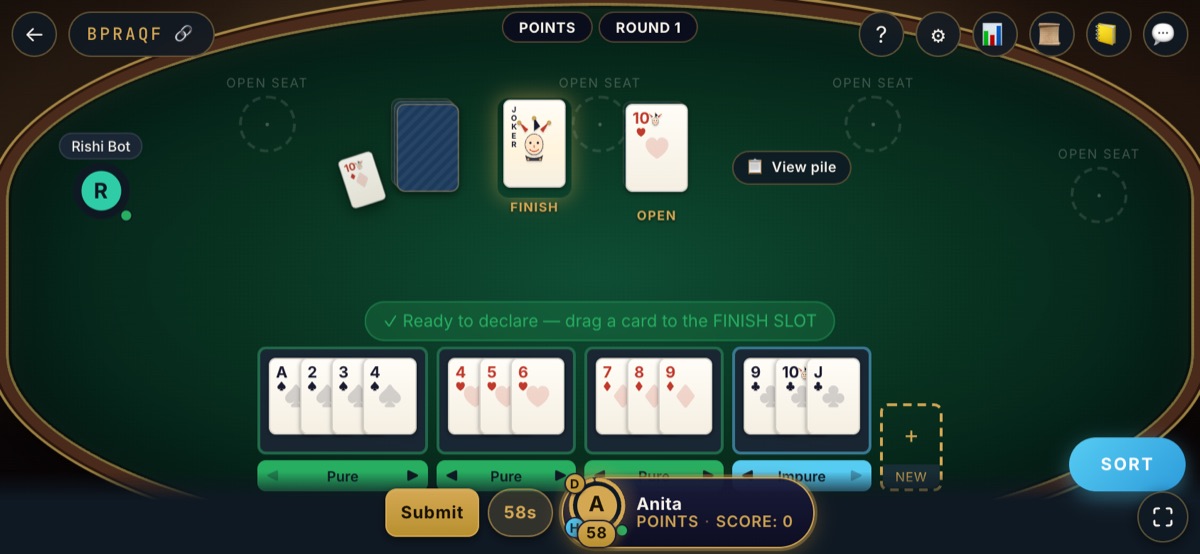
- Press Declare and choose the card for the finish slot.
- You have 60 seconds to arrange your groups and submit them.
- The server checks the hand. If it is valid, you win the round and score 0; every other player then gets time to arrange their own cards to reduce their score.
- If it is invalid, you take an 80-point penalty and the round ends. It goes to the other player still in — or, if several are, to whoever is holding the fewest points.
In real games on RummyDen, about one declaration in twelve is invalid — usually because the pure or second sequence is missing. See what 2,259 real rounds tell us, or check a hand first with the hand validator.
Scoring
| Card | Points if left ungrouped |
|---|---|
| Ace, King, Queen, Jack, 10 | 10 each |
| 2 to 9 | Face value |
| Printed jokers and wild-rank cards | 0 |
- The winner scores 0.
- Each other player scores the cards that are not in a valid group, up to a maximum of 80 points (the cap).
- A first drop scores 20, a middle drop 40, and an invalid declaration 80.
RummyDen rule: when you lose, any valid sequence or set you formed is excluded from your score — even if you never completed a pure sequence. Many tables count every card in that situation. Our approach rewards partial progress; it does not change what you need to declare.
A worked example
Your friend declares. Fives are wild and you are holding:
Your score is 52 points. If those leftovers had added up to more than 80, the cap would hold you at 80. The points calculator does this arithmetic for any hand.
Dropping, leaving and sitting out
- First drop (20 points): fold on your first turn before drawing.
- Middle drop (40 points): fold at any later point.
- Leaving mid-round counts as a drop for that round; your seat is freed at the end of the round.
- Sitting out: you can choose to sit out upcoming rounds without leaving the table.
RummyDen rule: if you are disconnected when a new round is dealt — your phone locked, say — you are not dealt in and you score nothing for that round. You rejoin the next deal once you are back. If that leaves fewer than two players, the table pauses until someone returns.
Chips
Each round, losing players' points move to the winner as chips (points × the room's score multiplier, ×1 by default). Chips only keep score. They are free, cannot be bought, sold or withdrawn, and have no cash value. RummyDen does not offer real-money games — see our responsible play page.
Points, Pool and Deals
RummyDen tables play Points Rummy: every round is scored on its own and you can stop whenever your group likes. Pool and Deals Rummy carry scores across rounds; our guide to rummy formats explains how they work if you want to try them with a paper score sheet.
What the host can change
The host picks these when creating a room: the turn timer on the first screen, everything else under Show advanced options. They cannot be changed once the room exists. The rest of this page uses the defaults.
| Setting | Choices | Default |
|---|---|---|
| Turn timer | 30, 45, 60 or 90 seconds, or off | 30 seconds |
| Score multiplier (chips per point) | ×1, ×2, ×5, ×10, ×25, ×50 or ×100 | ×1 |
| First drop | 0 to 40 points, in steps of 5 | 20 |
| Middle drop | 0 to 80 points, in steps of 5 | 40 |
| Points cap (also the invalid-declaration penalty) | 40 to 80 points, in steps of 5 | 80 |
| Include printed jokers | On or off; off leaves 104 cards and only wild-rank jokers | On |
| Mark wild jokers | On or off (the small jester on wild-rank cards) | On |
| Skip disconnected players after | Off, 15, 30 or 60 seconds | Off |
| Allow guests, enable chat, allow spectators | Each on or off | All on |
The skip setting matters only when the player whose turn it is has lost their connection: their turn resolves after that many seconds (or sooner, if the turn timer runs out first), and it works even when the timer is off. If they had drawn, the drawn card is discarded; if not, they drop. The host cannot change the game itself: Points Rummy at a six-seat, two-deck table, wild-rank jokers in play, and an invalid declaration ending the round.
Agreeing house rules
Rummy is played with many local variations — different drop values, caps, joker rules and even card values. Before your group compares results with another table, agree the settings: number of decks, whether wild-rank jokers are used, the drop penalties and the cap. On RummyDen they are set once per room, so everyone at the table plays the same game.