Pure Sequence in Rummy: The One Group You Must Have
What a pure sequence is, why you cannot win without one, and a fast, reliable way to build it every hand.
In real games on RummyDen, 158 of 1,885 declarations were invalid, and the largest single cause was having no pure sequence at all: 33.5% of them (see our rummy statistics). Each of those cost the declarer the room's full-cap penalty, 80 points by default.
A run can look pure and still fail because of a RummyDen house rule: a card of the round's wild rank is always a joker, even in its natural place. With sevens wild, 6♦ 7♦ 8♦ is an impure sequence on our tables, fine as a second sequence but never the pure one a declaration needs.
What a pure sequence actually is
A pure sequence is a run of three or more consecutive cards, all of the same suit, with no joker used to fill any gap. That is the entire definition, and every word matters:
- Three or more cards. Two cards is never a sequence. Three is the minimum; four and five are perfectly fine too.
- Same suit. All hearts, all spades, all clubs, or all diamonds. You cannot mix suits in a run.
- Consecutive. The ranks must be in unbroken order, like 4-5-6 or 9-10-J.
- No joker. This is the part that makes it pure. The moment a joker stands in for a missing card, the run becomes impure, not pure.
So 6-7-8 of hearts is a pure sequence. So is 10-J-Q-K of clubs. But 6-7-Joker of hearts is not — that joker is filling the 8, which makes it an impure sequence instead.
One nuance worth knowing about the Ace. In Indian Rummy the Ace can sit at the bottom of a run, as in A-2-3, or at the top, as in Q-K-A. What it cannot do is wrap around the corner, so K-A-2 is not a valid sequence. Keep that in mind when you are counting a run near the ends of a suit.
Why a pure sequence is mandatory to declare
To make a valid declaration in 13-card rummy, all your cards must form valid groups, and among those groups you need at least two sequences, one of which must be pure. If the pure sequence is missing, the table treats your show as invalid no matter how well everything else is arranged. We cover the full show step by step in our how to declare guide, but the headline is simple: no pure sequence, no valid declaration.
What happens if you lose without one depends on the table. Many home games count a losing hand with no pure sequence at full value — every card, including those in otherwise valid groups — which can push you to the maximum. RummyDen is more forgiving: your valid sequences and sets are excluded from your score whether or not you completed a pure sequence, so partial progress still counts. Where the pure sequence is never optional is the declaration: without one, declaring costs that full-cap penalty. That is why experienced players lock the pure sequence down first.
Pure vs impure vs set: a quick comparison
It helps to see the three main group types side by side. Treat PJ below as a printed or wild joker.
| Example | Group type | Counts as pure sequence? |
|---|---|---|
| 4-5-6 of hearts | Pure sequence | Yes — same suit, consecutive, no joker |
| 9-10-J-Q of spades | Pure sequence | Yes — a longer run is still pure |
| 6-7-PJ of hearts | Impure sequence | No — a joker fills the gap |
| 5-PJ-7 of clubs | Impure sequence | No — joker replaces the 6 |
| 8-8-8 of three suits | Set | No — a set is never a sequence |
The takeaway: only the top two rows keep your declaration legal. Sets and impure sequences are useful, but they can never satisfy the pure-sequence requirement.
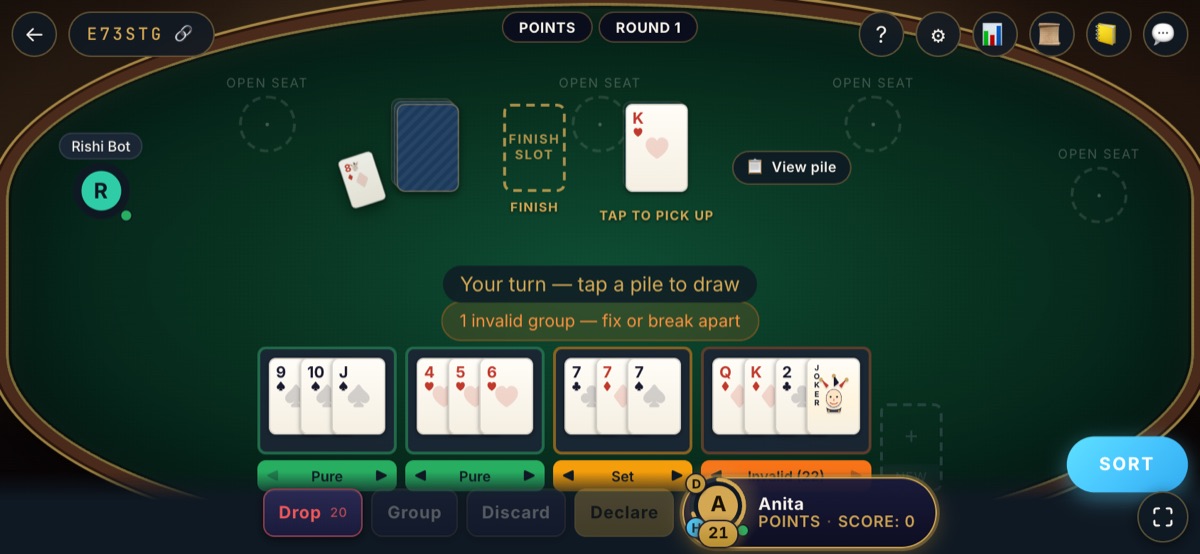
How to build a pure sequence fast
Speed here is really about priority. Build the pure sequence first, before anything else, and the rest of the hand falls into place. Work in this order:
- Sort by suit as soon as you are dealt. Line up all your hearts together, all your spades together, and so on. Runs jump out at you visually.
- Look for connected cards in one suit. Even a two-card start like 7-8 of diamonds is a live pure sequence — you only need one more card on either end, the 6 or the 9.
- Prefer open-ended draws. A 7-8 can be completed by a 6 or a 9, giving you two chances. A gap like 7-9 only completes with the single 8, so it is slower.
- Never spend a joker here. Save every joker for your impure sequence and sets, where they are allowed. A joker wasted inside a pure run is a joker thrown away.
- Lock it, then move on. Once three same-suit cards are in a row, drag them into their own group and do not touch them. Now build your second sequence and your sets around it.
Building pure-first also protects you late in the hand. If you run short of cards and a group has to break, it will be a set or an impure sequence that collapses — never the pure sequence that keeps your show legal. For the full turn-by-turn flow of drawing and discarding, our rummy rules page is the place to start.
Common mistakes to avoid
- Counting a wild-rank card as natural. With 5 as the wild rank, 4♣ 5♣ 6♣ is impure on RummyDen. Pairing it with 8♠ 9♠ JK gives two sequences but neither is pure. Check the wild rank before declaring; the table marks those cards with a small jester unless the host has turned the marker off.
- Wrapping the Ace around. Q-K-A is fine and A-2-3 is fine, but K-A-2 is not a sequence at all.
- Mixing suits by accident. On a busy table it is easy to slot a 6 of hearts next to a 7 of diamonds. Same colour is not the same suit.
- Holding a two-card run too long. A lone 7-8 is not a sequence yet. If the connecting cards are not coming, be ready to pivot rather than clinging to it all game.
- Spending a joker to rush a pure sequence. The instant you do, it stops being pure. Jokers belong everywhere except here.
A quick worked example
Say you are dealt these cards in one suit and want your pure sequence sorted first. You are holding 5 and 6 of hearts, plus a scatter of other cards and one joker. On an early turn you draw the 7 of hearts. That gives you 5-6-7 of hearts — a clean pure sequence, no joker, locked in group one. Now your joker is completely free to help build an impure sequence or a set elsewhere, and you have met the hardest requirement of the hand early. Every later decision is now about the other groups.
Want to check a hand? Load an example in the hand validator and try removing the pure sequence to see the declaration fail. Then read how to declare for the full pre-declaration routine.