Rummy terms glossary: every word you'll hear at the table
A plain-English dictionary of the melds, moves, and scoring words that come up in every game of 13-card Indian Rummy.
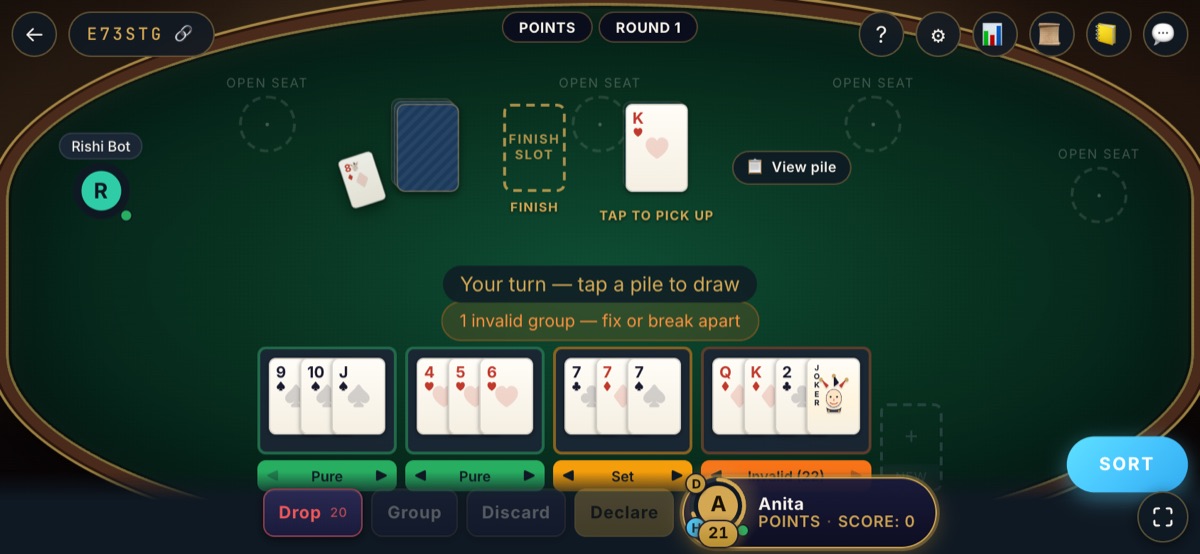
Under each group of three or more cards in your hand, a RummyDen table prints one of four labels: Pure, Impure, Set or Invalid. "Invalid (22)" means the group is not a meld yet and its cards would count 22 points if the round ended now. The labels follow RummyDen's rules, so a run that contains a card of the round's wild rank is labelled Impure even when that card sits in its natural place. This glossary explains those labels and the other words you will meet at the table, starting with the ones specific to RummyDen.
For the exact scoring and edge cases, the full rules page is the source of truth; to see the table in action, follow the how-to-play walkthrough.
Words you will see on a RummyDen table
- Finish slot — the dashed space beside the open pile. Placing your 14th card there and pressing Declare starts your declaration.
- Arrange window — after Declare you have 60 seconds to submit your groups; after a valid declaration every other player gets the same window to group their own cards.
- "2 more" / "1 more" — the label on a group of fewer than three cards, showing how many more it needs before it can be checked.
- Wild marker — a small jester on cards of the round's wild rank, shown unless the host turns it off. Those cards act as jokers for the round.
- Sit out — skip upcoming rounds without leaving your seat. Players who are disconnected when a round is dealt sit it out automatically, with no penalty.
- Chips — free score tokens. Losing points move to the round's winner as chips; they have no cash value.
The building blocks: melds, sequences and sets
Meld
A meld is any valid group of cards you have arranged, either a sequence or a set. Your whole aim in rummy is to organise all 13 cards into valid melds. The word is a catch-all: when someone says they have four melds, they mean four completed groups.
Sequence (run)
A sequence, also called a run, is three or more consecutive cards of the same suit, such as 5-6-7 of hearts. Sequences are either pure or impure, and a declaration needs at least two of them, one pure.
Pure sequence
A pure sequence is a run with no joker helping out, for example 9-10-J of spades; every declaration needs one. Our pure sequence guide covers how to build it.
Impure sequence
An impure sequence is a run that uses a joker to stand in for a missing card, such as 4-5-joker of clubs, where the joker plays the role of the 6. It counts as a completed sequence, but it can never satisfy the pure-sequence requirement.
Set
A set is three or four cards of the same rank, each a different suit, such as K♥ K♦ K♠. A joker can stand in for a missing suit, but a set can never repeat a suit or hold more than four cards — even with two decks in play.
Jokers: the flexible cards
Printed joker
The printed joker is the actual joker card that comes in the deck, the one with the jester picture. It can substitute for any card to complete a set or an impure sequence, and it always carries zero points if left in hand at the end.
Wild joker (cut joker)
At the start of each deal, one card is turned up and its rank becomes the wild joker for that hand, also called the cut joker. If the 7 of diamonds is turned up, then with two decks the other seven cards of that rank are wild and can substitute for any card, just like the printed joker. On RummyDen, if the turned card is a printed joker, aces are wild. The wild rank changes every deal; our jokers guide explains how to use both kinds.
The table layout: decks and piles
Closed deck
The closed deck is the face-down pile in the centre. You draw from it blind, so you never know what you will get, but your opponents also cannot see what you picked. Most careful players prefer the closed deck to keep their hand a secret.
Open deck (discard pile)
The open deck, or discard pile, is the face-up pile of cards that players have thrown away. You may pick the top card here instead of drawing blind, but everyone sees exactly which card you took, which leaks information about what you are building.
Taking your turn: draw, discard and drop
Discard
To discard is to throw one card onto the open deck at the end of your turn. Every turn is draw one, discard one, so your hand always returns to 13 cards. Choosing what to discard, and reading what opponents discard, is where much of the skill lives.
Drop
To drop is to quit the current hand for a fixed penalty instead of playing it out: a first drop before your first draw (20 points by default) or a middle drop after it (40). Knowing when to fold a hopeless hand is a core part of good rummy strategy.
Ending the hand: declare, show and scoring
Declare
To declare is to announce that all 13 of your cards are arranged into valid melds. You place your final card face down on a finish slot and lay your hand out for checking. A correct declaration ends the hand and scores you zero, the best possible result.
Wrong show (invalid declaration)
A wrong show is an invalid declaration, such as a hand with no pure sequence or a set that repeats a suit. The player receives the room's full-cap penalty. On RummyDen an invalid declaration always ends the round.
Deadwood
Deadwood is the collection of cards in your hand that are not part of any valid meld when the round ends. Those cards are counted against you: number cards at face value, 10s, picture cards and aces at 10, and jokers at zero (see the rules). On RummyDen your valid melds never count, even without a pure sequence.
Full count
The full count is the room's cap for counted deadwood and the penalty for an invalid declaration: 80 points by default, and a host can set it between 40 and 80. Running out of time is not a full count: a timeout before drawing counts as a drop, and a timeout after drawing discards the card you just drew.
Formats: points, pool and deals
Points
Points rummy scores each round on its own, with nothing carried over. It is the format every RummyDen room plays.
Pool
Pool is a home format in which each hand's points add to a running total and players are knocked out once their total passes a limit, commonly 101 or 201; the last player left wins.
Deals
Deals is a home format with a fixed number of deals, in which each deal's losers pass chips to its winner and the most chips at the end wins. Pool and Deals rules are explained in Points, Pool and Deals, and you can track either on the printable score sheet.
Want the essentials on one page? Print the 13-card rummy cheat sheet.